Most workplaces buy a first-aid kit once, mount it on a wall, and never think about it again until the day someone actually needs it and finds an empty box. A first-aid program is not a purchase. It is a rhythm. The employers who breeze through a safety inspection are not the ones with the biggest kits. They are the ones who can show that supplies are checked, restocked, and documented on a predictable schedule.
This guide lays out a practical restock rhythm any operator can run, the gaps inspectors flag most often, and a monthly checklist you can put to work this week.
Why a Restock Rhythm Beats a One-Time Purchase
Consumable supplies get used quietly. A few adhesive bandages here, a cold pack there, a pair of gloves grabbed for an unrelated cleanup. Nobody reports it, and the kit slowly hollows out. By the time you need it for something serious, the items that matter are expired or gone.
A rhythm solves three problems at once. It keeps supplies present and in date, it produces the paper trail that proves you are managing the program, and it spreads the cost into small predictable refills instead of one painful annual scramble.
Presence: the right items are physically there when the moment arrives.
Currency: nothing is past its expiration date, which is one of the most common write-ups.
Proof: a dated log shows an inspector you run a real program, not a wall decoration.
Set Your Baseline First
Before you can restock on rhythm, you need to know what "full" looks like for your workplace. Stocking levels scale with headcount, the hazards on site, and how far you are from outside help. A quiet office and an active warehouse should not carry identical kits.
Match the Kit to the Work
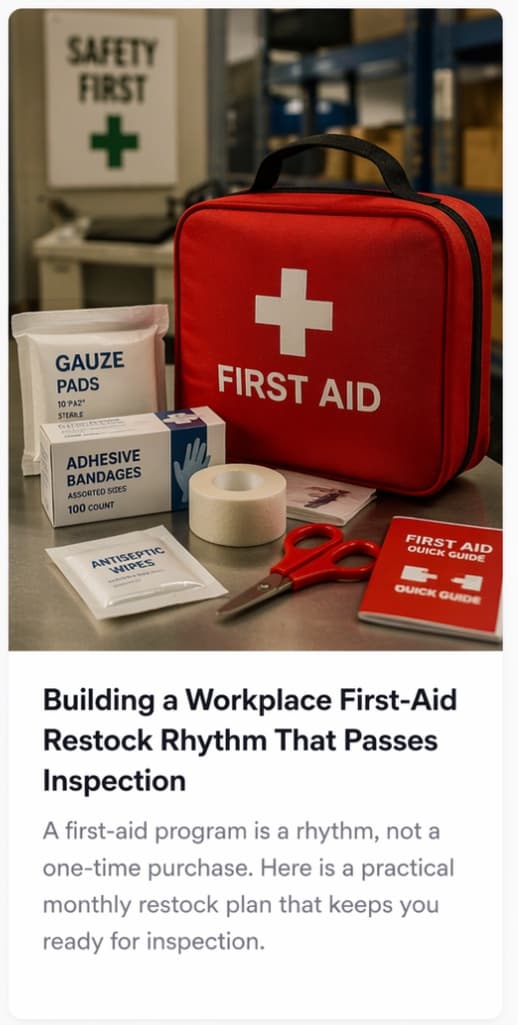
Low-hazard sites (offices, retail floors): bandages, antiseptic wipes, gauze, tape, gloves, a CPR barrier, and a basic burn treatment.
Higher-hazard sites (warehouses, shops, kitchens): everything above plus larger trauma dressings, eyewash, splinting material, and more burn coverage.
Headcount scaling: larger crews and multiple shifts need more units and often a second station so the supply is never a long walk away.
Distance to help: remote or single-exit sites should carry deeper supplies because resupply and response both take longer.
Write your baseline down as a simple par list: item, target quantity, location. The par list is the backbone of every restock after this, because restocking just means topping each item back up to par.
Build the Cadence
A workable program runs on three loops at different speeds. You do not need software for any of it. A clipboard or a shared sheet is enough.
Monthly: The Quick Top-Up
Open every kit and station and count each item against par.
Refill anything below par from your back stock.
Glance at expiration dates on anything within a few months of turning over.
Sign and date the log. The signature is the part inspectors care about.
Quarterly: The Deeper Pass
Pull and replace anything expiring before the next quarterly check.
Confirm seals, latches, and signage are intact and the station is clean.
Re-read your par list against any changes in headcount, new equipment, or new tasks on site.
Reorder back stock so your monthly top-ups never run dry.
Annually: The Program Review
Reassess hazards across the whole site and adjust par levels to match.
Verify the people responsible for the kit still hold current training.
Review the past year of logs for patterns, such as one item that always runs out, which usually signals an underlying issue worth fixing.
The Gaps Inspectors Flag Most
Across workplaces, the same handful of problems come up again and again. None of them are hard to prevent once you know to look.
Expired contents: the kit is full but half of it is out of date. A rhythm with date checks kills this gap.
Empty or raided kits: supplies were borrowed and never replaced. Back stock plus monthly top-ups close it.
No documentation: you maintain the kit but cannot prove it. The dated log is your evidence.
Wrong location or blocked access: the station is locked, hidden, or behind clutter. Stations must be obvious and reachable.
Mismatched stocking: an office-grade kit on a high-hazard floor. The par list keeps the kit matched to the work.
Missing PPE consumables: gloves and barriers run out fastest because they get used for everything. Treat them as high-turnover items.
Your Monthly Restock Checklist
Copy this and run it the same day each month. The whole pass takes most operators under thirty minutes once par lists exist.
Locate every kit and station on site.
Count each item against its par level.
Refill everything below par from back stock.
Remove and replace anything expired or expiring soon.
Check that gloves, barriers, and other PPE consumables are well above minimum.
Confirm the station is clean, sealed, visible, and unobstructed.
Note anything you could not fully restock and add it to the reorder list.
Sign and date the log.
How DLM Helps
DLM Solutions Group has packaged the restock rhythm into ready-to-run bundles so you are not chasing individual items. The Workplace Compliance Bundle ($299) anchors a documented program for offices and facilities with the core supplies and PPE consumables inspectors expect to see in date. The First-Aid Restocking Bundle ($249) is built for the monthly top-up itself, keeping your high-turnover items at par without a special order each time. For crews working away from a fixed station, the Field Safety Bundle ($219) carries deeper trauma and PPE coverage for jobsites where help and resupply are both farther away.
All bundles ship within the US. Browse the full lineup at dlmsolutionsgroup.com/supplies, and if you are outfitting multiple sites or shifts, request volume pricing on our bulk quotes page.
DLM Solutions Group has supported workplace operators with reliable consumable supply since 2022.